The problem wasn't that I had nothing to write down. Quite the opposite. There was too much to write down. And on the days when I felt bad — the very ones it would have been most useful to keep — the last thing I felt like doing was writing a diary.
That's where the MyHistamate journal started: to let me log enough to be useful later, but so simply that I'd use it on a bad day too.
Why it's worth logging
At first I tried to keep everything in my head.
If a food made me feel bad, I was convinced I'd remember it. If I had a migraine, itching or bloating, I tried to work out what I'd eaten before.
Except that, after a few weeks, all the days started to look alike. When the doctor asked me "when did they start?" or "do you notice they come after something in particular?", my answers were more like guesses: "in the evening, I think", "after cheese, maybe", "it seems to be before my period".
Only when I started logging consistently could I look back and compare, understand how my body reacts and what my patterns are.
Because a single day says very little. When the same thing repeats over several days, it starts to get interesting.
And that's exactly what's hard to do from memory.
How you log a day in MyHistamate
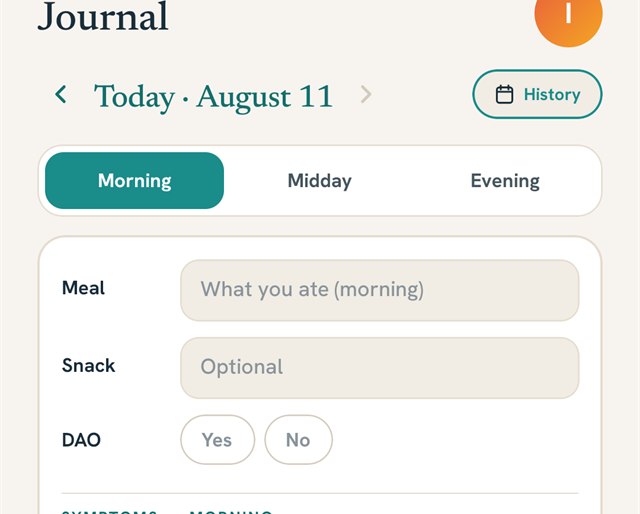
The journal is split into moments of the day, and most things are filled in with a few taps.
In the morning, for example, I can log what I ate, how I slept and how my digestion was. At lunch I add the meal and, if it applies, the fact that I took DAO. In the evening I add dinner and any symptoms.
Symptoms don't have to be described in paragraphs. I pick what I had and the intensity on a scale from 1 to 5. Symptoms are personal, you define them when you set up your profile, and you can track as many as you like.
At the top I then see a very simple summary of the day, something like:
"2 meals · digestion fine · no symptoms"
For me, that difference matters. It doesn't feel like a form to fill in. It just feels like I've left a few markers about that day.
Meals don't have to be written from scratch every time either
The foods are already in the app and have a basic classification based on the SIGHI list. And the app remembers your preferences and helps you fill things in if it notices a pattern in how you eat.
But on top of the general classification comes something more important: your own tolerance.
Because a list can say a food is problematic, and you may tolerate it perfectly well. Or the other way round.
If you already know a food suits you, you can mark it in your profile. MyHistamate takes that into account instead of treating the same list as an identical rule for everyone.
What happens with all this information?
This is where the journal starts to be more than a list of what you ate.
At the end of the week, MyHistamate gives you a summary of the days you logged: how the week was, which symptoms came up and what seems to have repeated or appeared in the same context.
As more weeks add up, you can also see trends over time: when more difficult days appear, whether there are certain times of the month when you feel different, or whether something is starting to repeat.
And when you have a specific question, you can talk to the Histamate assistant. The difference is that it can look at your journal, not just at today.
That seems to me one of the most useful parts. When I feel bad, the first impulse is to ask myself:
"What did I eat today?"
But the answer isn't always in the last meal. Sometimes it's worth looking at several days and the context around them.
If you want to understand the idea of build-up better, I explained it simply in the article about the histamine bucket.
All the important information then ends up on the home screen, so you don't have to search through the journal every time.
But what if one day I don't feel like logging anything?
Then you don't log everything.
That was important to me from the moment I designed the app: the journal shouldn't only work on the days when you have time and feel well.
If I have a hard day, I can log the bare minimum, and come back to it another day if I think it's needed.
An incomplete journal, used for months on end, can tell you far more than one filled in perfectly for ten days and then abandoned.
Does it really take two minutes?
On an ordinary day, yes — about two minutes in total, split into a few very short moments, or written all at once before bed.
MyHistamate is on the App Store and Google Play
The app has come out of testing and can be installed from the App Store and Google Play.
The first seven days are free and complete, with no card.
I started MyHistamate precisely because I couldn't keep up with classic diaries. I don't think the solution was for me to become more disciplined. I think the journal had to become easier to keep.