Sooner or later, after a period in which you've taken foods out of your diet, the moment for reintroductions arrives too. You can't stay indefinitely with a list that keeps getting shorter. The idea is to start, gradually and carefully, to test foods and see what you can bring back into your eating.
Why I test a single food at a time
I've done the opposite as well. After a more restrictive stretch, one evening I ate a little cheese, something with tomatoes, and I also had a glass of wine. The next day I didn't feel well. Except I hadn't learnt anything useful. Was it the cheese? The wine? The tomatoes? The combination?
That's where the simple rule I try to keep to now comes from: if I want to find out something about a food, it has to be the only new thing.
It's also the idea behind the histamine bucket: sometimes you're not reacting to one single thing, but to several factors adding up. If you change them all at once, it becomes very hard to understand what happened.
What a reintroduction looks like in MyHistamate
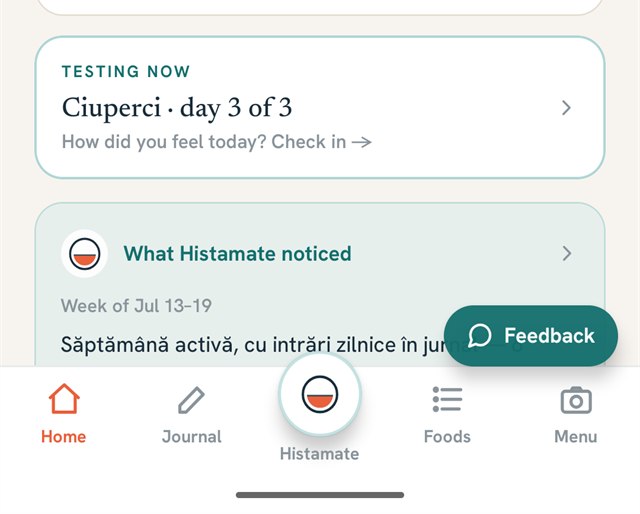
In the app I choose the food I want to test and start the reintroduction.
I don't have to remember which day I started on or what comes next. The test stays visible on the home screen as well.
I prefer to start with a small amount and keep the rest of my meals as close as possible to the ones I already know I tolerate. Then I follow how I feel for a few days.
Every day the app simply asks me whether symptoms appeared or not. If they did, I can note them in the journal too.
There's no need for a complicated table, or for me to write out "day 1, day 2, day 3" myself. MyHistamate keeps track of the test for me.
Why I don't rush
At first I wanted to test as many foods as possible, as fast as possible.
But if you start one food today, another tomorrow and yet another the day after, you end up in the same situation again: you have symptoms and you no longer know what they mean.
So I prefer to leave a little space between tests and not to start a new one if I haven't yet come back to my usual state.
Not because there's some universal rule saying everyone has to do exactly the same, but because otherwise the information becomes very hard to interpret.
What happens after the test
Here I find it very useful that the result doesn't stay only in a note I'll probably never find again.
If a food was tolerated, I can mark it as such in my tolerance map.
From then on, MyHistamate takes my experience with that food into account. It no longer starts only from a general classification, but also from what I've observed over time.
If the test doesn't go well, the food stays in the history too, together with the moment I tested it. And that seems important to me: "I didn't tolerate it now" doesn't automatically mean "I'll never tolerate it". Tolerance can change, and if after a while I want to retest it, at least I have somewhere to start from.
What I do if symptoms appear
If I notice I'm not feeling well, I don't try to force the test through just to "finish" it. I stop it, note what happened and go back for a while to the things I already know. Only when I feel steady again do I think about the next food.
For me, this part was hard to learn. I had the feeling that taking a break meant "losing time". In reality, when I rushed things, I ended up with more questions than answers.
I don't pick just any week for reintroductions
I've noticed there are periods when it simply isn't worth drawing conclusions too quickly from a test. If I'm sleeping very badly, I'm very stressed or I'm in a phase of my cycle when I have more symptoms anyway, it's harder to separate the reaction to the food from everything already going on in the body.
I've written separately about the role of sleep and stress and about the link between the cycle and histamine.
In periods like that I'd rather postpone the test than cut out a food just because I tried it at a bad moment.
The app organises the test. It doesn't decide for me.
MyHistamate helps me keep track: what I'm testing, when I started, how I felt and what the result was. But it doesn't decide which food I should test, and it doesn't turn reintroductions into a universal medical protocol.
Especially if you've had significant reactions or your diet is already very restricted, it's worth discussing the reintroduction process with the doctor or dietitian who is treating you.
MyHistamate is on the App Store and Google Play
The app has come out of testing and can be installed from the App Store and Google Play.
The first seven days are free and complete, with no card.
At the start, for me "managing HIT" mostly meant taking things off the plate. Over time I understood that the goal can't be to arrive at a smaller and smaller list.
Reintroductions are how I try to find out what I can bring back, not just what I have to avoid.